Google AI has become one of the biggest blessings of this era, one that could ever be showered upon humans. It has the power and influence to reshape the way humans used to interact with technologies in the past. Affirmatively, it has eased the lives of many people from how they used to work. What only started as a research initiative has now been integrated into the lives of mankind. It has empowered smartphones and productivity tools and has created many complex dashboards.
Initially, Google AI was built to make information more useful and easier to access, but with the passage of time, it has evolved and made itself integrated into the roots of almost everything that people use in today’s time. It helps understand complex queries, summarizes information, and even generates answers to your queries. Google increasingly acts as an intelligence agent that understands your concern and context, and gives a relatable answer to your query. This technological shift has impacted the way people used to consume information before the birth of Google AI.
The Origins of AI:
The Google AI’s journey was never an overnight miracle; it evolved with time. Earlier in time, the organization was using machine learning programming to search and optimize rankings and filter spam, but later on, back in 2011, the organization found a jackpot that Google itself is a deep learning research project within the company. Jeff Dean and Andrew Ng led the foundation work, explaining that large-scale deep learning could be achieved easily.
In 2014, Google made its first move that would reshape its identity over the future years. It attained a DeepMind, a research lab that originated in London. It wasn’t just a startup; it was a vision for the future. It wasn’t just an ideology it was an engineering challenge. Under Google’s shadow, DeepMind developed AlphaGo, the program that once defeated Go Players, attracting the attention of the scientific community and remaining in headlines. It was alarming that Google AI had done something exceptional and had become the star of the show.
DeepMind has diversified its potential, making it bound not only to games, but perhaps it has expanded it towards medicine too. AlphaFold, the lab’s most consequential sequence that cracked biology’s biggest challenge. Predicting the three-dimensional structure of a protein. It has developed an amazing breakthrough for medicine, drugs, and discovery, also understanding of life itself.
Google’s Brain Revolution
Although DeepMind had captured the attention of the general public, Google Brain was silently playing with the foundation of the near future. Researchers at Google Brain were busy publishing a paper titled “ Attention is All You Need,” which highlighted the transformer architecture. This model became the backbone of virtually every major AI system that followed, OpenAI’s GPT series, Meta’s LLaMA, and Google’s own language models.
The transformer’s potential to process and relate information across various sequences of text, paying selective attention to the most relevant part, was its major role. It allowed the creation of large language models that could understand the context, generate related text, translate language, and even write code.
Without the transformer, the Google AI would simply not exist.
Bard, Gemini, and Race for Generative AI
The birth of ChatGPT in late 2022 caught the attention of the technological world off guard. Whereas Google has been actively working on the launch of its own AI for many years. Bard is a conversational AI assistant powered by its LaMDA and, later on, PaLM language model. While Bard’s premature birth had mixed reviews from the public, its debut performance had some errors. Google quickly took it back to correct its fault.
The foremost substantial development came through Gemini. A sneak peek of it was made in late 2023, whilst progressively it came out in 2024 and 2025. Gemini represents Google’s most aspiring AI model to date. Unlike its forefathers, Gemini was made to generate text, images, audio, video, and code in general in such a way that they remain intact rather than treating each other as separate entities.
Gemini comes in all sizes, such as Ultra, Pro, and Nano. Each case is designed to act and behave differently according to the needs and desires of the user. From complex reasoning to simple reasoning, which can be done on smartphones. The Nano version was designed with features such as real- time voice assistant, and on-device summarization without facing the hassle of sending back the data to the cloud.
AI across Google’s Ecosystem
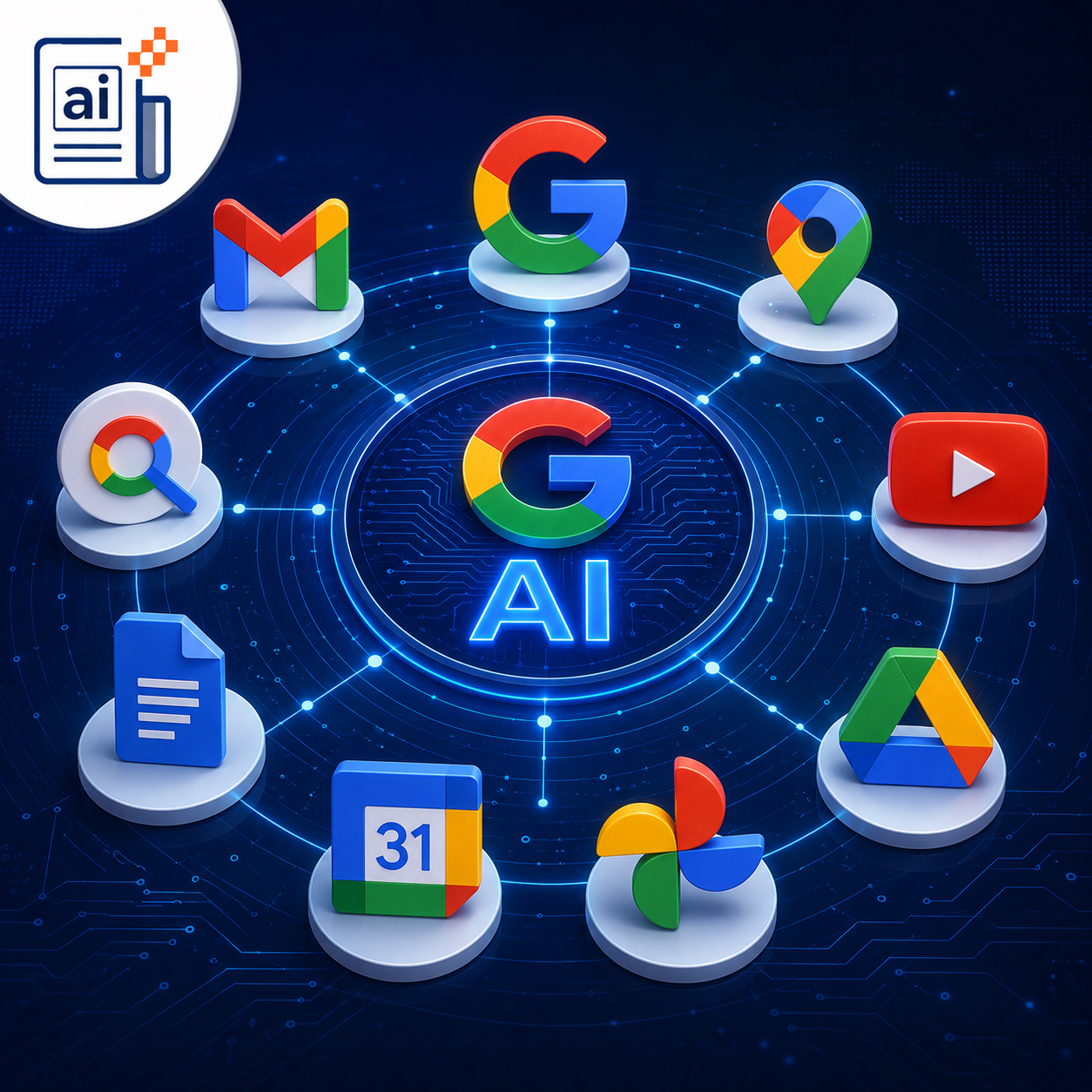
What makes Google’s AI different from its competitors is that it can offer several products and services through its AI capabilities. Gmail uses Google AI to draft emails and even suggest replies according to the nature of the email. Filter emails respectively to their concerned email sections, such as junk and spam, if any. Google Photos uses machine learning to organize images according to faces. It lets you experience folders according to images of only that specific person in that folder. It uses machine learning to search and enhance images. Also, Google Maps allows AI to lead and predict traffic, suggest fastest routes, and identify businesses.
Google Translate used to work as a processor that provided you with a synonym of a word, but now, as time has evolved and with the use of Google AI, it has also leveled up its capabilities to such an extent that it has become a neutral translation system that handles idioms with fluency.
Final Verdict:
Google AI’s dominance doesn’t come without any challenges. Just like many other organizations, being at the top had to face some challenges Google also had to face them. Questions are raised about the biases in the AI systems, the environmental cost of training to get that model, and the raised concerns about the privacy breach. All these aspects are major aspects of challenges.
The concern no longer lingers on whether Google AI has reshaped the future or not; it indeed has made a drastic change. The concern is whether this change or advancement will have a positive impact on the lives of the public in the long run or not!